After the global visibility of RRR, and the Hollywood’s conversations and the worldwide.
The journey of Peddi is ultimately more than just Ram Charan’s next big film. It is increasingly beginning to look like a conscious return to the cultural soil that shaped him. Many had expected Ram Charan to continue pursuing his Pan India spectacle however the actor had chosen a rural drama directed by Buchi Babu Sana. The filmmaker is known for producing charged stories deep rooted with the local identities and the class realities.
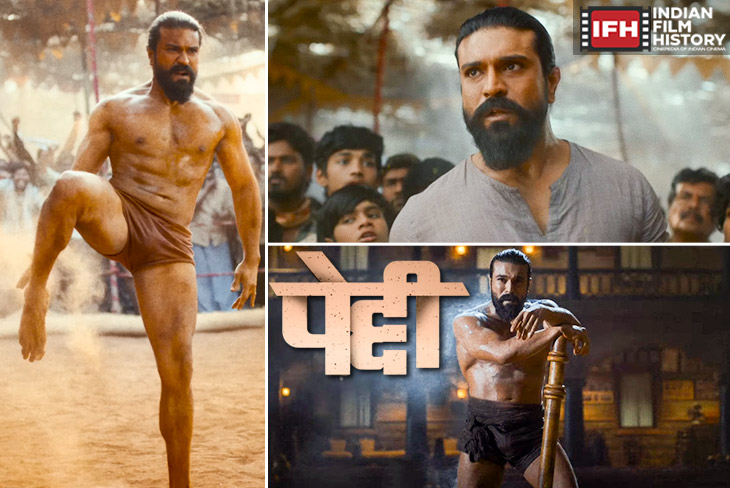
The first glimpse of Peddi.
Ram Charan’s transformation has stood out in Peddi. Now its not about the royal physicality that was associated with RRR like before. In its place is a rough-edged man with an unruly hair, mud covered soiled skin and the physical exhaustion shown on this face whose destiny is shaped by his hard work rather than his privileges.
The emotional pull of Peddi has come from how familiar the world felt to him says the actor. Speaking about the film Ram Charan also said the project connected to him because of its rootedness. There was something very honest about the world of Peddi says the actor. The people, the emotions, the environment is what I have grown up watching and somewhere it reminded the actor of the soil and the culture that he always carried within him.
The connection has shaped his performance in the film the way he approached the character in true sense physically. Unlike the styled heroes who dominate the cinema largely today in a large scale, Peddi seems to be grounded for its body language and is of what reminds us of the working class. It is close to the Andhra Men, or the wrestlers or the athletes, labourers, or simply the villagers whose strength comes from their own survival instincts.
Industry insiders say Charan was involved in preserving the authenticity of the character’s dialect and physicality. Several portions of the film were reportedly shot in harsh outdoor conditions, with the actor choosing realism over personal comfort in order to maintain the texture Buchi Babu wanted.

The decision is crucial because Peddi arrives at a time when audiences are increasingly craving regional flavours instead of generic pan-Indian storytelling. The film’s imagery is stark - village cricket, wrestling pits, mud fields and emotionally charged crowd sequences, that leans heavily into Telugu nativity rather than trying to smooth it out for broader markets.
For Ram Charan, that appears to have been part of the attraction. He says, “After travelling so much and seeing how people across the world responded to Indian cinema, I realised something very important - the more specific and rooted we are, the more universal the emotion becomes. Peddi is extremely local in its spirit, and that is exactly why I felt strongly about doing it.”
That philosophy shows a larger shift currently happening in Telugu cinema, where stars are increasingly embracing stories tied to geography, dialect and community identity rather than chasing culturally neutral spectacle.
In many ways, Peddi represents Ram Charan at his most stripped-down: less concerned with image, more interested in emotional texture. The film does not position him as a distant larger-than-life figure. Instead, it places him directly in the mud, sweat and chaos of rural life. And that is what makes Peddi one of the most intriguing films of his career so far. For all the scale surrounding the project, its emotional hook seems surprisingly intimate, it is about a global star reconnecting with the world he never really left behind.